


Fourth Quarter 2025 Newsletter
Market Commentary
Financial markets delivered small positive gains in the fourth quarter, and 2025 marked the third consecutive year of double-digit returns for balanced portfolios. Asset prices continue to navigate a complex environment characterized by easing monetary conditions, higher long-term interest rates, evolving inflation dynamics, and escalating geopolitical and policy uncertainty.
Rather than responding to each shifting market narrative, we remain focused on understanding how these conditions may influence portfolio risk, asset pricing relationships and an investment portfolio’s structural resilience.
Here are the key quarter and YTD market highlights:
Equities
S&P 500: +2.7% / +17.7%
TSX 60 +5.7% / +28.9%
Global Equities: +1.6% / +15.1%
Bonds
US Bonds: +0.9% / +7.2%
Canadian Bonds: -0.3% / +2.6%
High Yield: +1.4% / +8.8%
Balanced Portfolios
Global 60/40: +1.8% / +13.0%
Fortress Portfolio Positioning and Outlook
The Anchor Pacific Fortress Portfolios are strategically designed to provide a high degree of confidence in the portfolio’s ability to navigate a wide range of market environments over a long-term investment horizon. We operate one core investment model and adjust portfolio weightings based on individual client risk tolerance and capacity for uncertainty, with longer (shorter) horizons and higher (lower) tolerance for short-term losses resulting in more aggressive (conservative) asset allocations.
Activity in the fourth quarter was quiet, and portfolios ended the year largely unchanged from the previous quarter with respect to holdings and positioning. We anticipate subtle shifts during the coming months as we monitor the portfolios for potential vulnerabilities and opportunities.
Our present asset allocation for the Fortress Balanced Model Portfolio which targets an asset mix of 40% higher-risk assets, 40% medium-risk assets, and 20% defensive assets, is below.
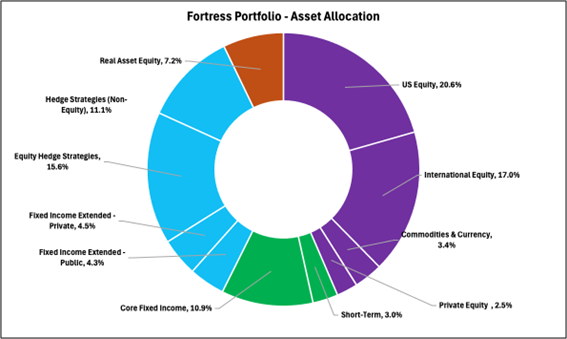
The following chart shows how the portfolio’s asset sector composition changed over the past year, with our most notable adjustment being the re-weighting of global geographic equity exposure that took place back in the second quarter.

Investment Process
In last quarter’s letter, we revisited our first principles for long-term success: culture, structure and process and unpacked our firm’s values and culture as well as the foundational pillars that underpin our investment philosophy.
We now carry this forward to discuss how these principles translate to our investment process.
Firstly, consistent and reliable performance is a byproduct of a robust framework and process for analysis, decision-making and implementation.
Secondly, the most critical attribute for successful implementation of institutional-level investment models is the establishment of a proper governance structure overseeing the long-term mission for the investment portfolios – this is where a financial plan and an investment policy statement factor into the equation. Foundational characteristics include capital that is permanent and patient with a long-term orientation focused on the portfolio’s total return in the context of quantifiable and observable measures of acceptable risk.
Next comes the orientation and alignment with each unique client – what are their priorities, goals, needs and constraints? What is the time horizon upon which capital is expected to be withdrawn and used elsewhere? What is an appropriate level of risk to expect given the client’s tolerance and capacity for risk?
Once all these variables have been discussed and decisions have been made, the long-term strategic mix of asset classes and strategies is established. The Strategic Asset Allocation (“SAA”), as it is known, is designed to produce the highest expected rate of return within a prudent and disciplined risk framework that produces a quantifiable risk target or goal. Academic research demonstrates that an investor’s SAA drives close to 90% of the lifetime returns of an investment portfolio and thus getting this decision correct is extremely important.
From there, managing the investment portfolio involves three main activities:
Investment selection is the process whereby specific investment and strategies are researched and evaluated for portfolio inclusion (answers the question of “what and how much we will we own?”)
Portfolio construction is the process whereby asset classes, strategies, and other discrete investment opportunities are analyzed in combination with one another, and culminates with the selection of the specific investments that comprise the investment portfolio (answers the question of “what role will each investment play in the total portfolio and how will it interact with the other investments held?”)
Risk management is the measurement, monitoring and evaluation of portfolio risks to determine what future actions are necessary to fortify the portfolio (answers the question “what adjustments need to take place given the current environment?”)
These activities operate on a continuum given the dynamic nature of global markets and our duty to improve process, structure, execution and ensure client outcomes are met with maximum satisfaction.
Looking Ahead
Looking ahead, we’ll be watching carefully many of the same themes and forces from previous years as well as a few newer ones:
Tariff related economic uncertainty and geopolitics
Stock and bond correlations
Equity valuations
AI mania
Inflation/stagflation
Fiscal spending and elevated sovereign government debt levels
Debasement of the US dollar
Supply/demand dynamics for natural resources and commodities
Rather than optimize for any single outcome or forecast, we focus on constructing portfolios that can endure uncertainty, absorb shocks during periods of market stress, and compound steadily over time. This consistency of process remains our greatest edge.
As our long-term views tend to be relatively sticky in nature, we expected measured portfolio activity with deliberate restraint. Portfolio adjustments are always incremental and purposeful rather than reactive, reflecting our belief that disciplined, well-timed refinements that are consistently applied are far more powerful than frequent and dramatic shifts in strategy.
These types of decisions while rarely headline making, are instrumental in protecting capital and improving long-term risk-adjusted outcomes over full market cycles.
Closing Thoughts and Looking Ahead
As we enter 2026, our outlook remains disciplined and measured. Markets will continue to fluctuate, narratives will shift, and uncertainty will persist. What will not change is our commitment to thoughtful portfolio construction, rigorous risk management, and long-term stewardship of your capital.


Comments